

Photography & Film
I built the studio system I couldn’t buy—and cut delivery to 48 hours.
I’ve worked inside this 20+ year family business since 2004. I connected booking, photo, video and delivery into one operating system—without automating away the human judgment that makes the work ours.

ONE HOME FOR THE FULL STORY
PRODUCT VISION
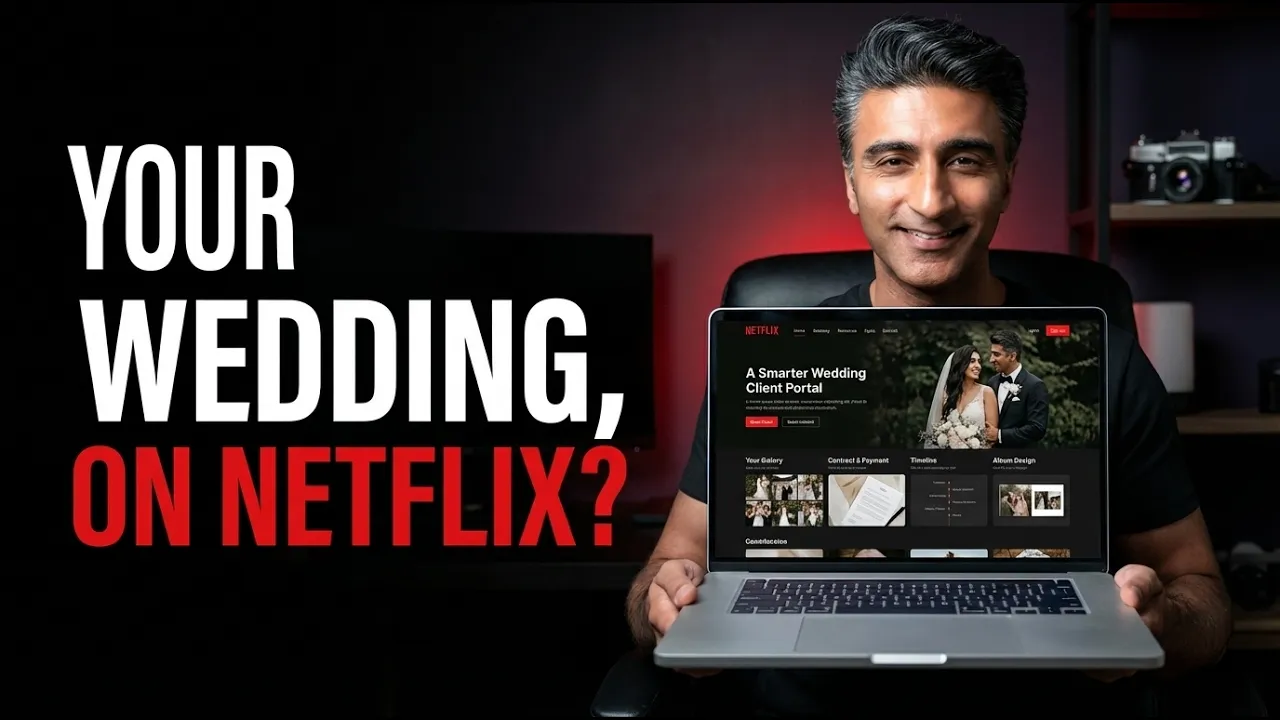
A clearer, cinematic home for the featured film, chapters, photographs and downloads.
THE BEFORE
01
The business had grown. The handoffs hadn’t.
I’ve worked inside Raj Photo Video since 2004. It’s a 20+ year family photography and film business, and I’ve worn every hat: consultations, booking, shooting, editing coordination, staffing, billing, delivery and client support. I wasn’t looking at the operation from the outside. I was living the handoffs myself.
The studio had a tool for almost every part of the job. The problem was that none of them carried the whole story:
HoneyBook handled bookings.
Imagen AI helped with photo editing.
Video still depended on manual Adobe Premiere workflows and detailed editor handoffs.
Pic-Time and VidFlow could present photos or video, but not the complete memory in one experience.
An event might take 6 hours to shoot. The coordination around it averaged another 10 hours: following up on music, explaining what happened to international editors, moving files, checking progress and rebuilding context at every handoff. Delivery commonly took 6–8 weeks, and sometimes longer.
I started working on the problem before practical agents were available. InstantEdit was an early 2024 attempt to remove bad footage and reduce repetitive video work. When capable agents became widely available in 2025, I saw the larger opportunity: connect the operation instead of improving one isolated step.
THE WORK
02
I designed the system around the business, not the tools.
I built Studio OS around one approved booking record. That record carries the event, people, promises, files and current status through four connected workflows: booking, photo production, video production and client delivery.
For video, the confirmed booking and the footage become the source of truth. Gemini APIs review the visual material and help reconstruct what happened across the event. A configured music library means production doesn’t have to wait for the client to choose songs. Together, those inputs give the film workflow the context I used to explain manually to an offline editor.
I was deliberate about what stayed human. Standard single-camera events can move through the automated production lane. Premium multi-camera films remain human-edited. AI can propose a cull, prepare an edit plan, run checks and move work forward. A person still approves the creative work and validates the final portal before anything reaches the client.
That boundary is also what makes the system ready for better agents over time. Each workflow has a defined entry point, a durable record, visible evidence and an approval boundary. An agent can prepare the next step, monitor progress or recover a failed handoff without being allowed to invent a client promise or release unfinished work.
The final experience brings the photographs, featured film, chapters and downloads into one place. The client doesn’t need to understand the machinery behind it. They just return to one home for the full story.
PRODUCT WALKTHROUGH
03
Photographs and films together, in one place.
This five-minute walkthrough shows the client experience and the operating model behind it—how the featured film, chaptered films, photographs and downloads come together in one connected home.
WATCH THE PRODUCT WALKTHROUGH
THE RESULT
04
The work after an event now starts immediately.
For the automated standard-event lane, owner-reported delivery moved from 6–8 weeks—sometimes longer—to about 48 hours. Production can begin as soon as the footage arrives because the booking context and music no longer have to be rebuilt by hand.
The coordination around each event went from about 10 hours to less than 15 minutes. That is more than a 97% reduction in hands-on coordination. Across an owner-reported range of 50–100 events a year, the model returns roughly 488–975 hours, or 12–24 forty-hour workweeks.
At a modeled owner-time value of $50–$100 per hour, that capacity is worth approximately $24,375–$97,500 per year. I treat that as capacity value, not booked cash savings: it represents time the business can redirect toward clients, creative work and growth.
The client-side proof is visible in Katie and Davel’s portal. In that tested gallery, every delivered photograph mapped to its full-resolution original while the web experience remained fast and easy to browse. The film, photographs and downloads live together instead of being split across separate delivery products.
Evidence note: the coordination, annual volume and delivery ranges are owner-reported operating estimates. The full-resolution gallery mapping is system-verified. The dollar range is a transparent capacity model using the assumptions above.
CLIENT NOTE
Jun 2, 2026
After an event, we used to spend hours explaining what happened, following up on songs and getting the right files to the right people. Now the system already has the booking, understands the footage and keeps everything moving. We can focus on the family and the film instead of chasing the process.
Raj Rijhsinghani
Share the case study: